Di/VerSo TriCi:KLo DeKla:MA:Zion MÖr:Phø-Poe-TiKa (x) PeriPhoN3O


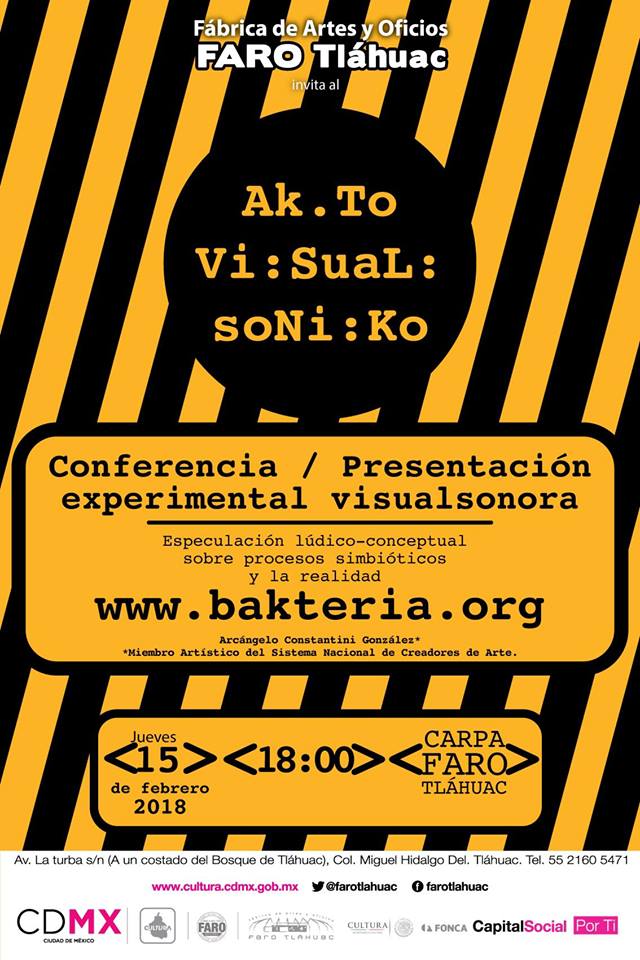
La Morfología es tanto el estudio de las formas y estructuras biológicas como las del diseño De la misma manera en lingüística estudia la estructura de las palabras. Los dadaístas desarrollaron la escritura automática, como un proceso poético en el que liberan al consciente y dejan fluir al subconsciente en la escritura de textos, Bakteria estructura a el lenguaje como un organismo que evoluciona, muta cambia y se transforma, con el advenimiento de los sistemas computacionales, un arsenal de caracteres ascii, simbolos del alfabeto fonético están en disposición de usarse para infectar la gramática y estetizar la lectura

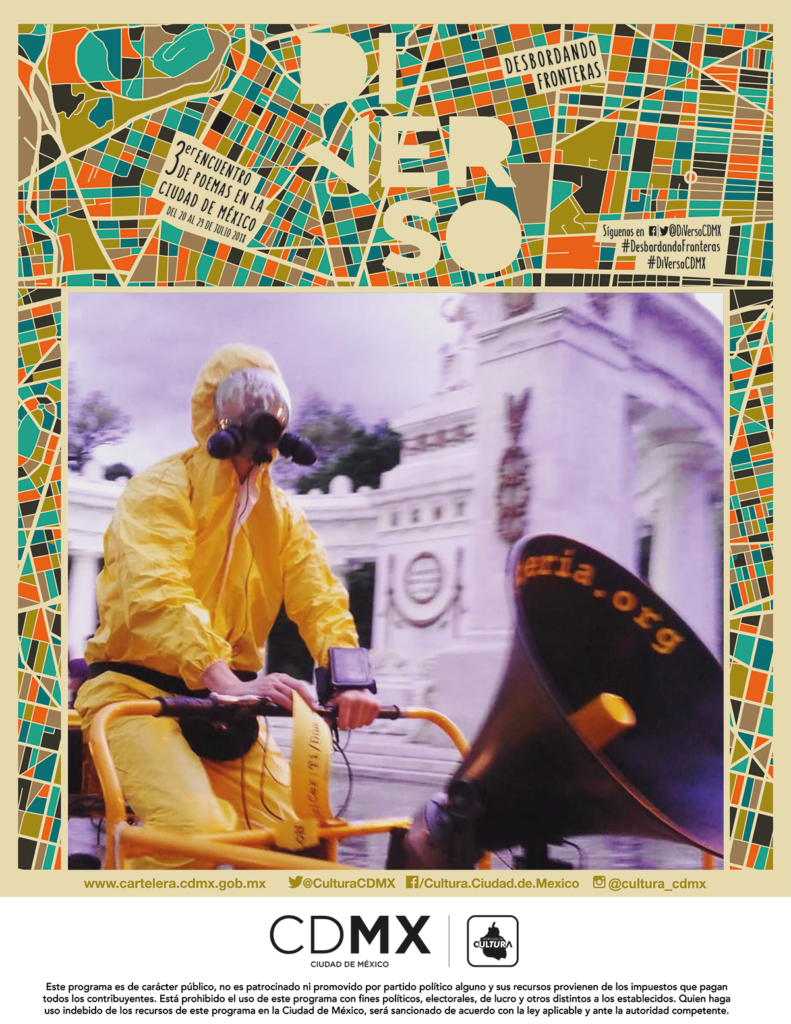
Un acto morfo poético de infección gramatical a palabras, que surgen del subconsciente como un proceso creativo no programado y sin sentido inmediato para la conciencia, son re-escritas para construir micropoemas léxicos, estas serán impresas en papel amarillo mezcladas y seleccionadas al azar Usando un Vocoder serán declamadas las palabras infectadas, la re-estructura morfológica es la pauta de lectura fonetica La lectura será en tiempo real circulando en un triciclo con un sistema de amplificación por perifoneo , el triciklo será un sistema de propagación léxica y poética

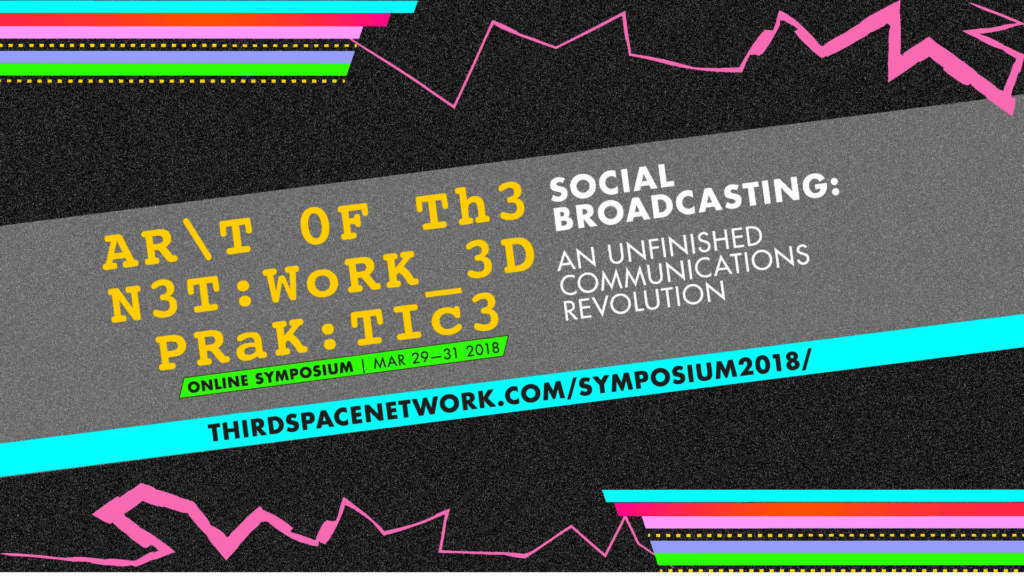
ÅrT ØF TH3 Nėt:WōRKeD PraKti_Ce ØnLiNe SyMPO:SiÙM


THE ART OF THE NETWORKED PRACTICE ONLINE SYMPOSIUM
A three-day international gathering presenting keynotes, live Internet performances, and global roundtable discussions.

THE ART OF THE NETWORKED PRACTICE ONLINE SYMPOSIUM is a collaboration between the School of Art, Design & Media at
Nanyang Technological University (Singapore); LASALLE College of the Arts (Singapore); & The School of the Art Institute of Chicago, Department of Performance (US)

MARCH 29 – MARCH 31, 2018
https://thirdspacenetwork.com/symposium2018/

LOGIN
All events are online via Adobe Connect Web conference
https://connect.ntu.edu.sg/thirdspacenetwork/
Download Adobe Connect Application if prompted
Select “Guest,” type your name, “Enter Room”

ONLINE REGISTRATION
http://bit.ly/net-symposium-registration
For event details, e-mailings and symposium participation

SYMPOSIUM CHAIR
Randall Packer, Associate Professor of Networked Art, Nanyang Technological University, School of Art, Design and Media, Singapore

KEYNOTES:
— Maria Chatzichristodoulou, Associate Professor in Performance and New Media, London South Bank University, UK
— Matt Adams, Blast Theory Co-founder, UK

LIVE NETWORKED PERFORMANCES:
— Online En-semble – Entanglement Training: Directed and performed by Annie Abrahams (FR) with Antye Greie (FI), Helen Varley Jamieson (DE), Soyung Lee (KR), Hương Ngô (US), Daniel Pinheiro (PT), Igor Stromajer (DE), and NTU students.
— igaies: Directed and performed by Jon Cates (US) with Roberto Sifuentes (US), Arcángelo Constantini (MX), Shawné Michaelain Holloway (US), 愛真 Janet Lin (US) & Paula Pinho Martins Nacif (UK) (XXXtraPrincess)

| ABOUT |

The Art of the Networked Practice Online Symposium is an international gathering presenting emerging research, artistic work, and technological innovation in the networked arts. Intended as a global and inclusive gathering, with no registration fees, the symposium unites local and remote speakers and audiences from all corners of the world via Webconferencing, bridging Singapore with an active international new media arts community that transcends geographic and cultural boundaries. The symposium demonstrated how networked space can be used to activate live performance and online artistic work, stimulate creative dialogue, and encourage open sharing of knowledge through an online global exchange.

| SOCIAL BROADCASTING: AN UNFINISHED COMMUNICATIONS REVOLUTION |

Media historian and activist Gene Youngblood signals the need for “a communications revolution… an alternative social world” that decentralizes the experience of the live broadcast through the creative work of collaborative communities. In response to Youngblood’s call-to-action, the Art of the Networked Practice Online Symposium will have as its theme, “Social Broadcasting: An Unfinished Communications Revolution.” Through the presentation of keynotes, live performances, and global roundtable discussions, the Art of the Networked Practice Online Symposium explores the concept of social broadcasting and its histories as a revolutionary shift from one-to-many streaming and performance modalities to distributed peer-to-peer interactions that creatively join artists and audiences in live, networked spaces.

| PROGRAM @ A GLANCE |

::: Day 1: Thursday, March 29,
School of Art, Design and Media, Nanyang Technological University, ADM 3-25, Singapore
7am-10am CDT-Chicago / 8am-11am EDT-East Coast / 1pm-4pm BST-UK /
2pm-5pm CEDT-Central Europe / 8pm-11pm SGT-Singapore

[Being & Connectedness in Telematic Space]

INTRODUCTIONS: Randall Packer, Symposium Chair; Vibeke Sorensen, Chair, School of Art, Design and Media, Nanyang Technological University, Singapore
KEYNOTE: Maria Chatzichristodoulou: Live Art and Telematics: The Promise of Internationalism
LIVE NETWORKED PERFORMANCE: Online En-semble – Entanglement Training directed by Annie Abrahams with collaborators
POST-PERFORMANCE GLOBAL ROUNDTABLE DISCUSSION: Moderated by Maria Chatzichristodoulou and Annie Abrahams with collaborators

::: Day 2: Friday, March 30
LASALLE College of the Arts, Block F, Level 3, Room F309, Singapore
7am-10am CDT-Chicago / 8am-11am EDT-East Coast / 1pm-4pm BST-UK /
2pm-5pm CEDT-Central Europe / 8pm-11pm SGT-Singapore

[Networking the Real and the Fictional]

INTRODUCTION: Steve Dixon, President, LASALLE College of the Arts, Singapore
KEYNOTE: Matt Adams: The Here, the Now, the Audience and the Spectator
GLOBAL ROUNDTABLE DISCUSSION: Moderated by Maria Chatzichristodoulou and Steve Dixon

::: Day 3: Saturday, March 31
School of the Art Institute of Chicago, Department of Performance, Performance Space 012 (Columbia Bldg basement)
10am-1pm CDT-Chicago / 11am-2pm EDT-East Coast / 4pm-7pm BST-UK /
5pm-8pm CEDT-Central Europe / 11pm-2am SGT-Singapore

[igaies – intimate glitches across internet errors]

INTRODUCTION: Jon Cates, Associate Professor Film, Video, and New Media, School of the Art Institute of Chicago, US
LIVE NETWORKED PERFORMANCE: igaies: directed by Jon Cates with collaborators
POST-PERFORMANCE GLOBAL ROUNDTABLE DISCUSSION: Moderated by Jon Cates and Roberto Sifuentes with collaborators
CLOSING: Randall Packer, Symposium Chair

See Program for specific times and details.
https://thirdspacenetwork.com/symposium2018/program/

| THIRD SPACE NETWORK |

The Third Space Network (3SN) is an Internet broadcast channel for the live media arts and creative dialogue. 3SN is a project of Randall Packer in conjunction with research at his studio in Washington, DC, and the School of Art, Design and Media, Nanyang Technological University in Singapore, where he is an Associate Professor of Networked Art.

https://thirdspacenetwork.com/
Twitter: @thirdspacenet
Facebook: https://www.facebook.com/thirdspacenetwork/

| SUPPORT |

The Art of the Networked Practice | Online Symposium is made possible through support from LASALLE College of the Arts, School of the Art Institute of Chicago, School of Art, Design and Media at Nanyang Technological University, along with grants from NTU CLASS, EdeX, and Startup Funds.




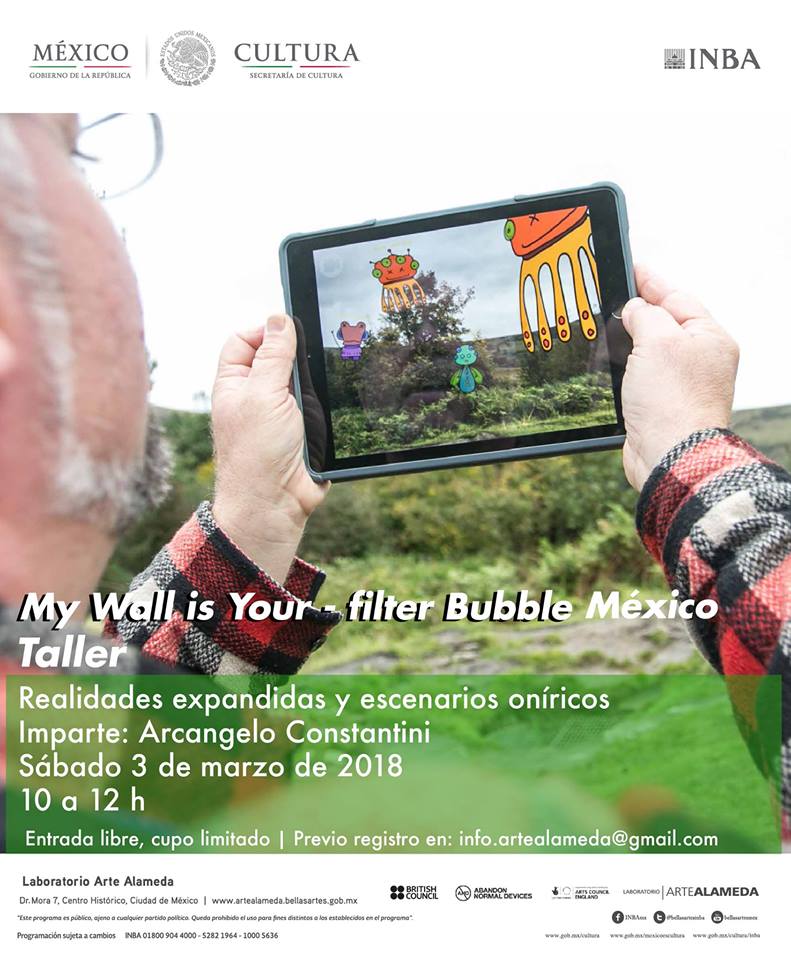
My WaLL Is YouR FiLTer BuBBLe

Este taller empoderará a los participantes a generar sus propios enlaces y conexiones a través de la colaboración. Abrirá paso al diálogo y buscará cerrar las grietas de comunicación que los filtros burbuja propician a través de la polarización de opiniones.
Registro previo: info.artealameda@gmail.com
British Council Mexico
#MWYFB #Tecnología #PensarenelInternet #Educación #LAA


GüT F33_LinGs: 3DS aNd The Mi-Kro:Bi.Om3

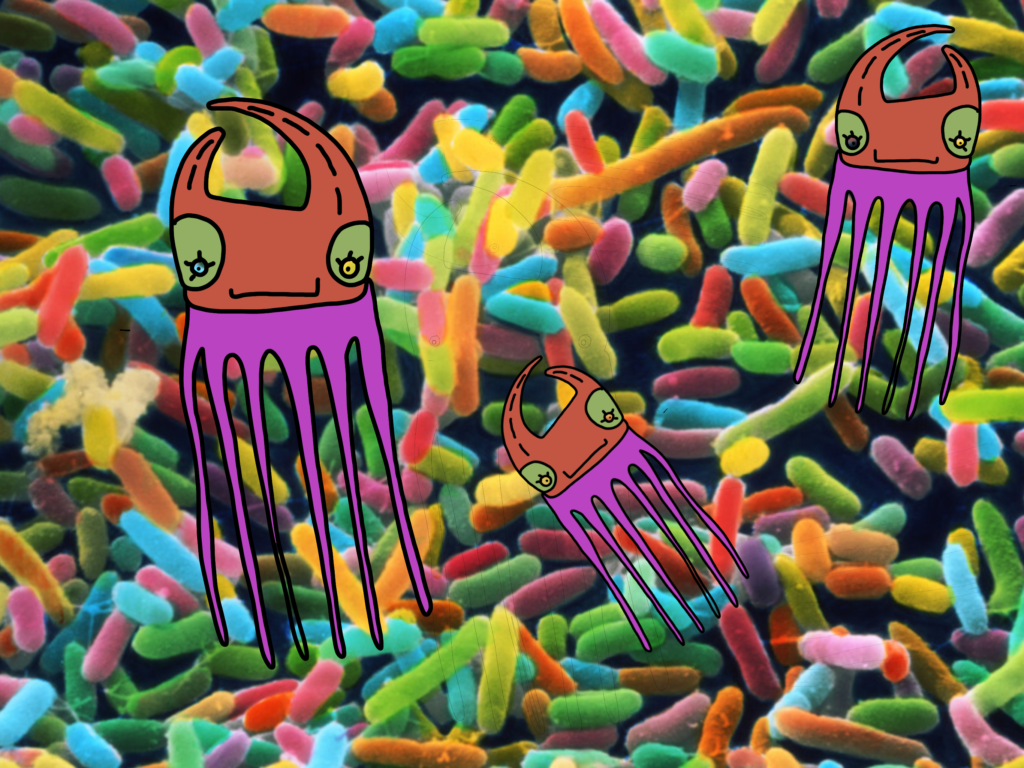
E. coli bacteria

www.edbites.com/2013/01/gut-feelings-eds-and-the-microbiome/


Consider this thought experiment:

Drop a person in a blender (since it’s all hypothetical, go ahead and make it someone you don’t like. Feel better? I bet you do!). Then, count all the total number of cells that are produced. Only one in ten of these cells will be human. The other 90%? Those are all microbes. If you look at the total number of genes in your human smoothie (NOT coming soon to a Jamba Juice near you), the numbers are even more skewed: only one in 100 genes are human. The rest are, again, bacterial. The total collection of all of these bacteria living in and on our bodies is known as the microbiome.

The idea isn’t to gross out the card-carrying germophobes among us. But let’s face it: we’re just as much bacterial as we are human. Plenty of these microbes live on our skin, in our lungs and genital tracts. The mother lode of microbes, however, live in our gut. They are crucial to extracting energy from food, and these microbes are extremely sensitive to what we eat. Starving mice for just one day dramatically alters the composition of their gut microbes. Specifically, it decreases a type of bacteria known as Firmicutes. When researchers transplanted Firmicutes into the guts of lean mice, they rapidly gained weight (Crawford et al., 2009)

When it comes to eating disorders, there isn’t much talk of microbes. There are the occasional papers from researchers like Sergei Fetissov about potential auto-immune responses in people with eating disorders, and some work on PANS (pediatric auto-immune neuropsychiatric syndrome) and anorexia, but generally, researchers haven’t looked at the role of the microbiome in triggering or perpetuating an eating disorder.

Much work has been done in obesity research. Scientists have consistently found that people with a BMI >30 have different gut microbes than people with BMIs in the “normal” range. As well, bariatric surgery also significantly changes gut microbes as people lose weight, making them look more similar to the bacterial profiles seen in “normal weight” individuals. A more recent study in The ISME Journal proposed a microbiome diet: eating foods that would eliminate a type of bacteria called Enterobacter helped a person lose drastic amounts of weight in a short period of time (Fei & Zhao, 2012).

So how are microbes involved in eating disorders? No one really knows. Cindy Bulik has begun a study looking at this relationship, but the results still aren’t in. Based on the studies above, it’s reasonable to assume that ED behaviors (starving, binge eating, and/or purging) will have a significant effect on a person’s microbiota. It still has to be measured, but I would bet a lot of money on it. The question is what do these microbial changes have to do with ED symptoms?

Imbalances in gut microbes in mice and rats have been found to alter patterns of risk-taking and anxious behaviors–something that also happens in people with EDs. They could also, perhaps, explain weight loss seen in anorexia and EDNOS. Maybe the initial restricting triggered a significant change in gut microbes that amplified the effects of malnutrition. Maybe they lacked a group of microbes that produced an important hormone regulating hunger and satiety. No one really knows.

One hint to the potential role of microbes in EDs comes from a study published today in the journal Science (Smith et al., 2013). The scientists studied the relationship between gut microbes and kwashiorkor, a form of severe malnutrition that occurs when a person doesn’t eat enough protein. Of the 317 twin pairs from Malawi that the researchers followed for three years, half became significantly malnourished and 7% developed signs of kwashiorkor. Obviously, a lack of protein is crucial to the development of this disease but it’s not the only factor as not everyone with a severely protein-deficient diet will develop kwashiorkor. Something else had to be going on.

First, the researchers treated twin pairs discordant for kwashiorkor (that is, one twin had it, whereas the other didn’t) with “ready-to-use therapeutic food”- basically peanut butter on steroids. Twins with kwashiorkor had significantly different from nearby twins who (presumably) at pretty close to the same diet. The researchers found significant changes to the gut microbes in the ill children with the use therapeutic food. Discontinuing the therapeutic food caused a regression in the functioning of the gut microbes.

The kicker is this: when the researchers fed mice a standard Malawian diet and inoculated them with microbes from the guts of malnourished children, they rapidly lost weight and also developed kwashiorkor. This happened despite the fact that their diets contained adequate calories. One of the reasons that the researchers believed the therapeutic food is so effective at treating kwashiorkor is that it helped restore normal gut microbes.

To say what effect restoring normal gut flora will have on ED symptoms remains to be seen. Probiotics are a hot item, but much of the research is fairly overblown. There’s definitely still potential there, and we need to know more about which populations of people are likely to benefit and which aren’t. But it’s an interesting idea, and I think we need to know a lot more about the role of the microbiome in the development and perpetuation of EDs.

In closing, a quote from scientist John Rawls in an interview with Scientific American:

“We are in the midst of a revolution of our ability to describe the composition and physiological potential of these bacterial communities…What we can begin to speculate on, though, are the different types of relationships that might be taking place. We know gut microbiota enhance our ability to extract calories from complex carbohydrates, which is clearly a mutually beneficial relationship. But it’s thought that all vertebrates have the capacity to digest and absorb other types of nutrients, such as lipids, proteins and simple carbohydrates, so it’s not readily clear how we could enter into a mutually beneficial relationship with bacteria with regard to those nutrients.”

Vi-Tri_Na Sub:JeTi.VA AKto PerFör:MatiKo F/A/N

Vi.Tri_NA Sub:JEti:Va

Li:ve Dra/WinG
LIv3 KoDinG
TiTo RoM3Ro
f3zTi-VaL Art3 NueVo
Chi.Hua:Hua
R34L tiMe
G3NeRaTiVe Dra_WiNg
NéuRoALgoriTHm

Mi-Krö:Bio/Ta (in)T3z.Ti-NaL R3Gü-La 3L SiSt3Ma (in)mi-NoˆLoGi-Ko


http://www.lavanguardia.com/ciencia/cuerpo-humano/20171030/432483141811/microbiota-intestinal-regula-sistema-inmunitario-colitis-ulcerosa-diabetes.html


ABRE LA VÍA A TRATAMIENTOS
Descubren cómo la microbiota intestinal regula el sistema inmunitario
Una bacteria del intestino es capaz de reclutar glóbulos blancos para que combatan la inflamación
Descubren cómo la microbiota intestinal regula el sistema inmunitarioMicrobiota intestinal en una muestra de heces (Scimat Scimat / Getty)
Comparte en Facebook Comparte en Twitter 4
CRISTINA SÁEZ
30/10/2017 08:45 | Actualizado a 30/10/2017 10:06
Investigadores del Institut d’Investigacions Biomèdiques August Pi i Sunyer (IDIBAPS), en Barcelona, y de la Universidad de Calgary, en Canadá, han descubierto un mecanismo por el que la microbiota intestinal regula la respuesta inmunitaria del organismo en enfermedades autoinmunes. Este mecanismo, afirman los investigadores, abre la vía a desarrollar nuevos tratamientos terapéuticos para enfermedades como la colitis ulcerosa o el Crohn.

En un estudio con ratones y publicado en Cell, los científicos han hallado que, cuando algunas células de defensa se equivocan y comienzan a atacar a otras células en el intestino provocando inflamación y enfermedades como colitis o Crohn, determinadas bacterias de la microbiota son capaces de “reclamar” a un tipo de glóbulos blancos, los linfocitos T, para que acudan al intestino, aplaquen la rebelión y supriman la colitis en los roedores.

“Creemos que este mecanismo está probablemente involucrado en prevenir que mucha gente desarrolle EII”, dice Kathy McCoy, de la Escuela de medicina Cumming de la Universidad de Calgary.

Determinadas bacterias de la microbiota son capaces de reclamar a un tipo de glóbulos blancos para que acudan al intestino y aplaquen la rebelión autoinmune

No obstante, este mecanismo beneficioso que ayuda a combatir enfermedades autoinmunes intestinales tiene una contrapartida. Según han visto los investigadores, esos glóbulos blancos, los linfocitos T, encargados de frenar la inflamación, también pueden reaccionar de forma exagerada ante células del páncreas y causar diabetes tipo 1.

Clave para la supervivencia

La microbiota intestinal, el conjunto formado por billones de microorganismos que habitan en el intestino, realiza funciones clave para la supervivencia, como proporcionar al organismo nutrientes y vitaminas, ayudar a digerir alimentos o educar al sistema inmunitario para que desarrolle su función. En este sentido, diversos estudios epidemiológicos recientes han constatado que cuando se producen alteraciones o desequilibrios en la microbiota intestinal, aumenta el riesgo de sufrir enfermedades autoinmunes, como asma, celiaquía o enfermedad inflamatoria intestinal.

“Sin microbiota, no se desarrolla correctamente el sistema inmunitario. Y eso se sabe desde los experimentos realizados a mediados del siglo pasado en que criaban ratones sin gérmenes y estos enfermaban y morían, incapaces de hacer frente a ningún patógeno”, explica Pere Santamaría, líder de grupo en Idibaps y profesor catedrático en la Universidad de Calgary.


(ktsimage / Getty Images/iStockphoto)
“Sabíamos, pues, que la microbiota intestinal estaba implicada en la regulación del sistema inmunitario pero se desconocía cómo de forma específica las bacterias regulaban e influían en las enfermedades. Y eso es, precisamente, lo que hemos descubierto”, afirma Santamaría, que ha liderado el estudio.

Así, han hallado que, cuando algunos glóbulos blancos comienzan a atacar las células del intestino, produciendo inflamación, una proteína de una especie de bacterias muy común en el intestino de los ratones y también de los humanos, llamada Bacteroides, penetra en la barrera intestinal y “llama” a los linfocitos CD8, otro tipo de células de defensa., que son capaces de reconocer estas proteínas. Al detectarlas, se dirigen al intestino y allí frenan la inflamación.

Los linfocitos que protegen contra la colitis también pueden causar diabetes tipo 1

“Estos linfocitos existen en el organismo porque protegen al individuo contra la colitis, que es un tipo de enfermedad inflamatoria intestinal. No obstante, hemos visto que el precio que hay que pagar es que a veces esos linfocitos CD8 también reaccionan con un antígeno muy parecido que está expresado en las células del páncreas. Y en ese caso pueden causar diabetes tipo 1”, añade este investigador.

El problema yace en que las proteínas que expresa la bacteria de la microbiota son casi idénticas a las expresadas por las célula del organismo, en este caso del páncreas, lo que puede crear confusión en los linfocitos CD8 y dar lugar a enfermedades autoinmunes.

“Si hemos encontrado el ejemplo de esta enfermedad –asegura Santamaria en referencia a la colitis ulcerosa- es muy probable que haya muchos más ejemplos por descubrir que explicarían las asociaciones entre la presencia o ausencia de ciertas bacterias en la composición de la microbiota y cambios en la incidencia y prevalencia de ciertas enfermedades autoinmunes a nivel de la población”.

El descubrimiento de este mecanismo abre la puerta a desarrollar tratamientos para tratar estas enfermedades autoinmunes

Los investigadores apuntan que el hecho de que las células de defensa CD8 desempeñen una acción antiinflamatoria en el intestino pero proinflamatoria en el páncreas tiene una explicación evolutiva.

“El cuerpo no necesita células que reaccionen contra el propio cuerpo y nos provoquen diabetes. De ser así solo, la evolución las hubiera eliminado. Si se han desarrollado y persisten es porque tienen un papel beneficioso para nuestra supervivencia. Hace cientos de miles de años era más peligroso tener una colitis ulcerosa que una diabetes tipo 1. Quizás por eso aún sigamos teniendo estas células, aunque el precio que paguemos sea que quizás algún día atacarán al páncreas”, afirma Santamaría.

El descubrimiento de este mecanismo abre la puerta a desarrollar tratamientos para tratar estas enfermedades autoinmunes. De hecho, este mismo grupo ha desarrollado una plataforma terapéutica basada en nanopartículas que podría aplicarse para emular o potenciar la acción de la microbiota y contribuir a la supresión de la colitis.

El cuerpo no necesita células que reaccionen contra el propio cuerpo y nos provoquen diabetes. De ser así solo, la evolución las hubiera eliminado. Si se han desarrollado y persisten es porque tienen un papel beneficioso para nuestra supervivencia”
PERE SANTAMARÍA
Líder del estudio

ChRon-iK FaTi-Gue SynDro-me is NoT in YouR H34D, is in YoüR GÜT

http://neurosciencenews.com/chronic-fatigue-microbiome-4581/


HomeFeatured
Chronic Fatigue Syndrome Is Not in Your Head, It’s in Your Gut
Neuroscience NewsNEUROSCIENCE NEWSJUNE 27, 2016
FEATUREDNEUROLOGYOPEN NEUROSCIENCE ARTICLES6 MIN READ

Summary: Researchers have identified biomarkers for chronic fatigue syndrome in gut bacteria and in inflammatory microbial agents in the blood.

Source: Cornell University.

Physicians have been mystified by chronic fatigue syndrome, a condition where normal exertion leads to debilitating fatigue that isn’t alleviated by rest. There are no known triggers, and diagnosis requires lengthy tests administered by an expert.

Now, for the first time, Cornell University researchers report they have identified biological markers of the disease in gut bacteria and inflammatory microbial agents in the blood.

In a study published June 23 in the journal Microbiome, the team describes how they correctly diagnosed myalgic encephalomyeletis/chronic fatigue syndrome (ME/CFS) in 83 percent of patients through stool samples and blood work, offering a noninvasive diagnosis and a step toward understanding the cause of the disease.

“Our work demonstrates that the gut bacterial microbiome in chronic fatigue syndrome patients isn’t normal, perhaps leading to gastrointestinal and inflammatory symptoms in victims of the disease,” said Maureen Hanson, the Liberty Hyde Bailey Professor in the Department of Molecular Biology and Genetics at Cornell and the paper’s senior author. “Furthermore, our detection of a biological abnormality provides further evidence against the ridiculous concept that the disease is psychological in origin.”

“In the future, we could see this technique as a complement to other noninvasive diagnoses, but if we have a better idea of what is going on with these gut microbes and patients, maybe clinicians could consider changing diets, using prebiotics such as dietary fibers or probiotics to help treat the disease,” said Ludovic Giloteaux, a postdoctoral researcher and first author of the study.

In the study, Ithaca campus researchers collaborated with Dr. Susan Levine, an ME/CFS specialist in New York City, who recruited 48 people diagnosed with ME/CFS and 39 healthy controls to provide stool and blood samples.

The researchers sequenced regions of microbial DNA from the stool samples to identify different types of bacteria. Overall, the diversity of types of bacteria was greatly reduced and there were fewer bacterial species known to be anti-inflammatory in ME/CFS patients compared with healthy people, an observation also seen in people with Crohn’s disease and ulcerative colitis.

Image shows gut bacteria.
The researchers sequenced regions of microbial DNA from the stool samples to identify different types of bacteria. Overall, the diversity of types of bacteria was greatly reduced and there were fewer bacterial species known to be anti-inflammatory in ME/CFS patients compared with healthy people, an observation also seen in people with Crohn’s disease and ulcerative colitis. NeuroscienceNews.com image is for illustrative purposes only.
At the same time, the researchers discovered specific markers of inflammation in the blood, likely due to a leaky gut from intestinal problems that allow bacteria to enter the blood, Giloteaux said.

Bacteria in the blood will trigger an immune response, which could worsen symptoms.

The researchers have no evidence to distinguish whether the altered gut microbiome is a cause or a whether it is a consequence of disease, Giloteaux added.

In the future, the research team will look for evidence of viruses and fungi in the gut, to see whether one of these or an association of these along with bacteria may be causing or contributing to the illness.

ABOUT THIS NEUROLOGY RESEARCH ARTICLE
Funding: The study was funded by the National Institutes of Health.

Source: Melissa Osgood – Cornell University
Image Source: This NeuroscienceNews.com image is in the public domain.
Original Research: Full open access research for for “Reduced diversity and altered composition of the gut microbiome in individuals with myalgic encephalomyelitis/chronic fatigue syndrome” by Ludovic Giloteaux, Julia K. Goodrich, William A. Walters, Susan M. Levine, Ruth E. Ley and Maureen R. Hanson in Microbiome. Published online June 23 2016 doi:10.1186/s40168-016-0171-4